


As a supplier of Thermoforming Cup Machines, I am often asked about the cooling process in these machines. Understanding this process is crucial for anyone involved in the production of disposable cups, as it directly impacts the quality, efficiency, and cost of production. In this blog post, I will delve into the details of the cooling process in a thermoforming cup machine, explaining its importance, the different methods used, and how it can be optimized for better results.
The Importance of Cooling in Thermoforming Cup Machines
Thermoforming is a manufacturing process where a plastic sheet is heated to its softening point, formed into a specific shape using a mold, and then cooled to maintain that shape. In the context of cup production, the cooling stage is essential for several reasons.
Firstly, proper cooling ensures the dimensional stability of the cups. After the plastic sheet is formed into a cup shape, it needs to be cooled rapidly to prevent it from deforming or losing its shape. This is particularly important for maintaining the uniform size and shape of the cups, which is crucial for stacking, packaging, and compatibility with other equipment.
Secondly, cooling affects the physical properties of the cups. Rapid cooling can enhance the mechanical strength and rigidity of the cups, making them more resistant to cracking and deformation during handling and use. It also helps to reduce the internal stress within the cups, which can otherwise lead to warping or other defects.
Finally, the cooling process plays a significant role in the production efficiency of the thermoforming cup machine. A faster cooling rate allows for shorter cycle times, which means more cups can be produced in a given period. This can lead to increased productivity and lower production costs.
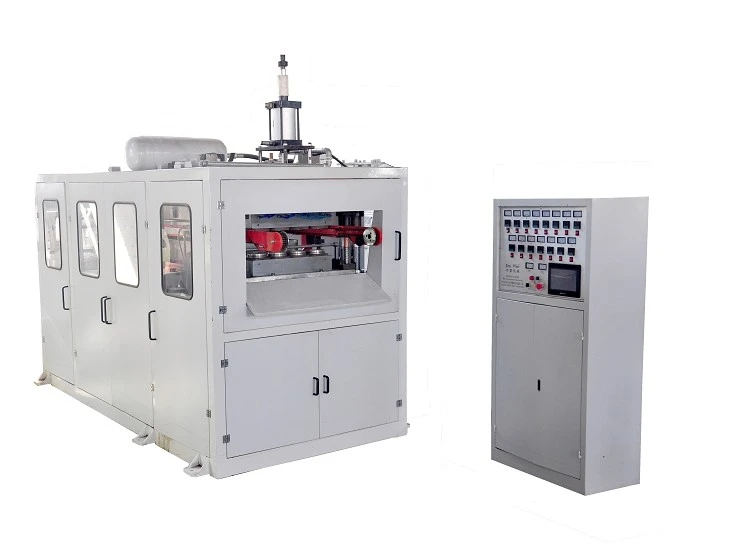

Cooling Methods in Thermoforming Cup Machines
There are several cooling methods commonly used in thermoforming cup machines, each with its own advantages and disadvantages. The choice of cooling method depends on various factors, such as the type of plastic material, the size and shape of the cups, and the production requirements.
Air Cooling
Air cooling is one of the simplest and most widely used cooling methods in thermoforming cup machines. In this method, compressed air is blown onto the formed cups to remove heat and cool them down. Air cooling is relatively inexpensive and easy to implement, making it suitable for small-scale production or when a quick and simple cooling solution is needed.
However, air cooling has some limitations. It is less efficient than other cooling methods, especially for thick-walled or large-sized cups. The cooling rate is also affected by factors such as the air temperature, humidity, and flow rate, which can make it difficult to achieve consistent cooling results.
Water Cooling
Water cooling is a more efficient cooling method compared to air cooling. In this method, the formed cups are cooled by direct contact with water or by using water-cooled molds. Water has a higher heat capacity than air, which means it can absorb more heat from the cups in a shorter time.
Water cooling can be further divided into two types: immersion cooling and spray cooling. In immersion cooling, the formed cups are submerged in a water tank to cool them down. This method provides a uniform and rapid cooling effect, but it requires a large amount of water and may cause water contamination. Spray cooling, on the other hand, involves spraying water onto the cups or the molds. This method is more flexible and can be used for different cup sizes and shapes, but it may require a more complex water circulation system.
Refrigerant Cooling
Refrigerant cooling is the most advanced and efficient cooling method used in thermoforming cup machines. In this method, a refrigerant is used to remove heat from the cups or the molds. Refrigerants have a very low boiling point, which allows them to absorb a large amount of heat when they evaporate.
Refrigerant cooling systems typically consist of a compressor, a condenser, an expansion valve, and an evaporator. The compressor compresses the refrigerant gas, which increases its temperature and pressure. The hot refrigerant gas then flows through the condenser, where it releases heat to the surrounding environment and condenses into a liquid. The liquid refrigerant then passes through the expansion valve, which reduces its pressure and temperature. Finally, the cold refrigerant liquid enters the evaporator, where it absorbs heat from the cups or the molds and evaporates back into a gas.
Refrigerant cooling provides a very high cooling rate and can achieve precise temperature control. It is suitable for high-speed production and for producing cups with high-quality requirements. However, refrigerant cooling systems are more expensive and complex to install and maintain compared to air or water cooling systems.
Optimizing the Cooling Process
To achieve the best results in the cooling process of a thermoforming cup machine, it is important to optimize several factors, including the cooling method, the cooling time, and the temperature control.
Choosing the Right Cooling Method
As mentioned earlier, the choice of cooling method depends on various factors. When selecting a cooling method, it is important to consider the type of plastic material, the size and shape of the cups, the production requirements, and the cost. For example, if you are producing thin-walled cups at a high speed, air cooling may be sufficient. However, if you are producing thick-walled or large-sized cups, water cooling or refrigerant cooling may be more appropriate.
Controlling the Cooling Time
The cooling time is another important factor that affects the quality and efficiency of the cooling process. If the cooling time is too short, the cups may not be fully cooled, which can lead to deformation or other defects. On the other hand, if the cooling time is too long, it can reduce the production efficiency and increase the energy consumption.
To determine the optimal cooling time, it is necessary to consider the type of plastic material, the thickness of the cups, the cooling method, and the temperature of the cups and the environment. In general, the cooling time should be long enough to ensure that the cups are fully cooled but not too long to cause unnecessary delays.
Maintaining Precise Temperature Control
Precise temperature control is essential for achieving consistent cooling results and ensuring the quality of the cups. In a thermoforming cup machine, the temperature of the cups, the molds, and the cooling medium needs to be carefully monitored and controlled.
For example, in a water cooling system, the temperature of the water should be maintained within a certain range to ensure effective cooling. In a refrigerant cooling system, the temperature of the refrigerant and the evaporator should be controlled to achieve the desired cooling rate.
Conclusion
The cooling process is a critical step in the production of disposable cups using a thermoforming cup machine. It affects the quality, efficiency, and cost of production. By understanding the different cooling methods available and optimizing the cooling process, manufacturers can produce high-quality cups at a lower cost and with higher productivity.
If you are interested in learning more about our Thermoforming Cup Machines or have any questions about the cooling process, please feel free to [contact us for procurement discussions](javascript:void(0);). Our team of experts is always ready to assist you and provide you with the best solutions for your cup production needs.
We also offer a wide range of cup-making machines, including Disposable Cup Forming Machine, Plastic Cup Making Machine, and Coffee Cup Machine. Visit our website to explore our product range and find the perfect machine for your business.
References
- "Thermoforming Handbook" by James F. Carley
- "Plastics Processing: Modeling and Simulation" by Osswald, T. A., & Turng, L. -S.
- "Manufacturing Engineering and Technology" by Serope Kalpakjian and Steven R. Schmid


